
This question comes up constantly in digital nomad forums and traveller communities, and most answers fail by trying to declare a winner. The truth is Bali and Bangkok suit fundamentally different things, and if you know what you’re optimising for, the answer is usually clear. This is the comparison that answers it honestly.
Our complete Bali guide and our Bangkok guide cover each destination in full — this article is specifically about the comparison for people choosing between them.
Cost — Closer Than People Think
The perception that Bali is significantly cheaper than Bangkok was accurate five years ago. In 2026 the gap has narrowed considerably, particularly in the Canggu/Seminyak tourist corridor.
Accommodation
Bangkok has a wider range at the budget end — hostels are cheaper, guesthouses in non-tourist areas cost less. At the mid-range ($50-100/night), the two are comparable — Bangkok gets you a decent serviced apartment, Bali gets you a villa with a pool (shared or private depending on location and price). At the top end, Bali offers private pool villas that are hard to match in Bangkok for the same money.
Monthly rental for a furnished apartment: Bangkok from $500 (basic) to $1,500 (decent central condo); Bali from $800 (basic villa in mid-Canggu) to $1,500-2,000 (well-located villa with private pool). Bangkok is cheaper at the lower end; Bali offers more value in terms of space and private facilities at equivalent prices. See our Bali cost of living guide and Bangkok cost of living guide for detailed breakdowns.
Food
Bangkok is cheaper for daily eating. Street food in Bangkok — pad thai, khao pad, boat noodles — costs 50-100 THB ($1.50-3) and is genuinely exceptional. Bali’s warung food is comparable in quality and slightly more expensive. The difference becomes more pronounced for western food: Bangkok’s expat restaurant scene is larger and the competition keeps prices lower. Bali’s cafes and international restaurants often charge a premium because the demand is high and the supply is more limited.
Visa — Bangkok Has More Flexibility
Bali / Indonesia
The Visa on Arrival (VoA) gives 30 days, extendable once for another 30 days — giving 60 days without leaving. The B211A Social Budaya visa (60 days, extendable to 180 days total) requires an agent and more paperwork but is manageable. The Digital Nomad Visa (Second Home Visa variant) exists and is genuinely available — see our Bali visa guide for the specifics. Long-stay in Bali requires more active visa management than Bangkok.
Bangkok / Thailand
Thailand offers 60-day tourist visas on arrival (extended to 60 days in 2024) and the Long-Term Resident (LTR) Visa which gives 10-year residency for qualifying digital workers (income requirements apply). Multiple-entry tourist visas from neighbouring consulates are straightforward to obtain. Bangkok has a more established infrastructure for visa runs if needed. The LTR Visa, if you qualify, is arguably the best long-stay option in Southeast Asia. See our Bangkok visa guide for details.
Internet — Bangkok Wins Clearly
This is the clearest category. Bangkok has significantly better and more consistent internet than Bali at every level: in accommodation, in cafes, and on mobile data. True Wifi and AIS in Thailand deliver 100-500Mbps in most urban accommodation. Bali’s residential internet averages 10-50Mbps with more frequent drops.
For coworking spaces, both cities have excellent options. Bangkok has more of them. For mobile data coverage, Bangkok’s AIS and DTAC offer faster and more consistent 4G than Bali’s Telkomsel in comparable urban areas.
If your work requires consistently fast internet — large file uploads, frequent video calls, real-time systems — Bangkok is the more reliable choice. Our Bali internet guide covers how to manage Bali’s connectivity constraints specifically.
Coworking
Both cities have mature coworking ecosystems. Bangkok has more spaces in absolute terms (it’s a much larger city) with more variety in pricing and facilities. Bali’s coworking scene — concentrated in Canggu and Ubud — is highly developed for its size and has a stronger community/social element. The Dojo Bali community in Canggu, for example, runs events and has a social cohesion that’s harder to find in Bangkok’s larger, more transient spaces. See our Bali coworking guide for the Bali-specific options.
Food and Lifestyle
Bangkok
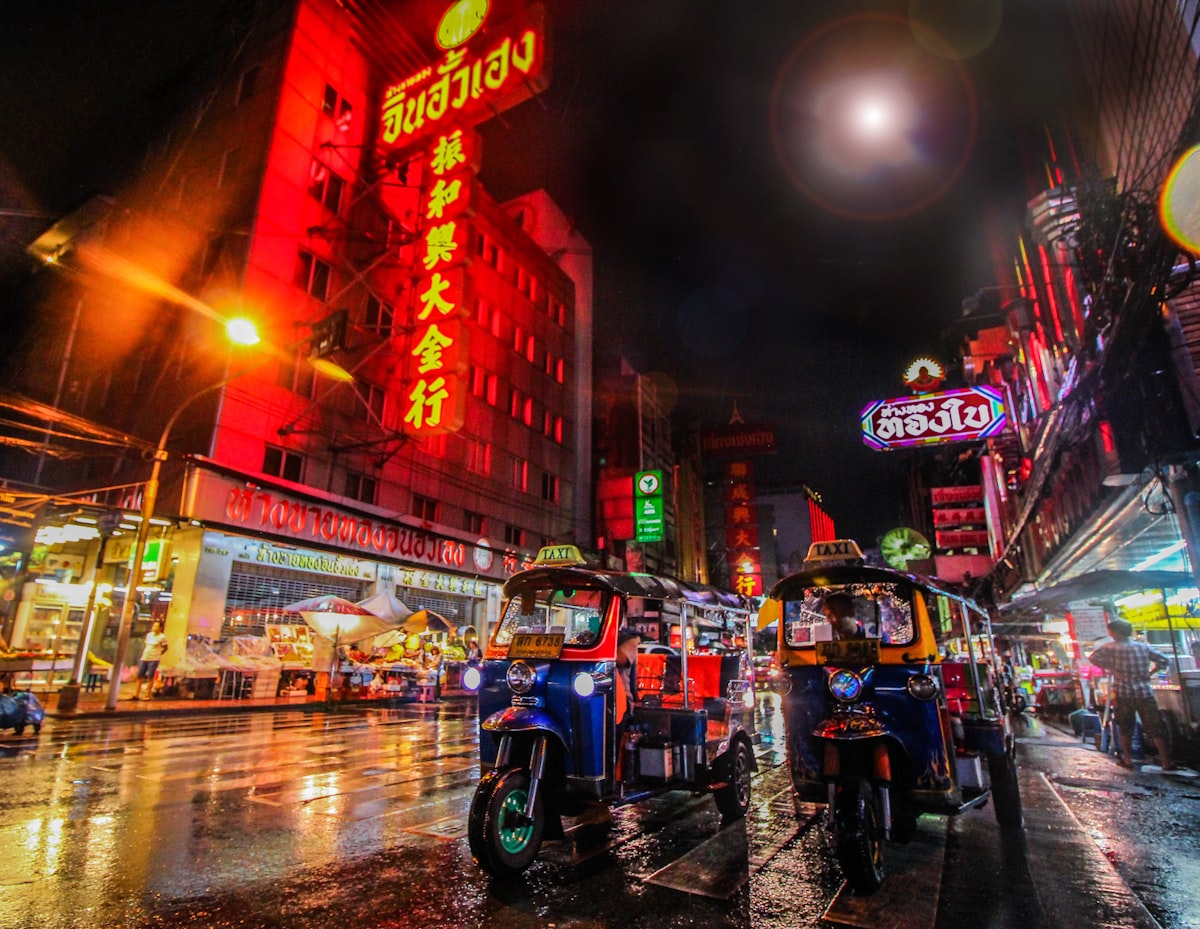
Bangkok has one of the great food cities on earth. The range is extraordinary: from 50 baht street food to Michelin-starred Thai fine dining to virtually every international cuisine. The city operates 24 hours. The nightlife is diverse. The shopping is excellent. The cultural scene — temples, museums, markets, river — is rich. It is also hot, congested, and full-on. Bangkok doesn’t have an off switch.
Bali
Bali’s food scene is narrower but strong — particularly for plant-based and health-conscious eating, for Indonesian regional food, and for the cafe culture that’s developed around the nomad community. The lifestyle is more nature-oriented: surfing, yoga, rice terrace walks, motorbike trips to temples. The pace is slower. The Hindu cultural overlay — daily offerings, ceremonies, the sound of gamelan — gives the island a character that urban Thailand doesn’t replicate. Our Bali digital nomad guide covers the lifestyle aspects in detail.
Transport
Bangkok: excellent BTS Skytrain and MRT subway, cheap Grab and metered taxis, reasonable ride-hailing. Getting around the city is genuinely easy once you understand the rail network. Traffic in Bangkok at peak hours is severe but the rail bypasses it.
Bali: no public transport worth speaking of. You need a scooter or hired driver for almost everything. This is a charm (freedom, spontaneity) and a constraint (you need to be comfortable with it, it adds cost and planning). Our Bali traffic guide is essential reading before you arrive.
Community and Social Life
Both cities have strong digital nomad communities. Bali’s is more concentrated — Canggu’s Batu Bolong strip is essentially a self-contained nomad village where you’ll meet the same people repeatedly. Bangkok’s is larger but more diffuse across the city. Bali is easier to build a social network quickly in if you stay in Canggu; Bangkok has more variety but requires more effort to find your community within it.
Who Each Place Suits
Choose Bali if:
You want nature proximity and outdoor lifestyle (surf, beach, rice terraces, hiking). You want villa living with a private pool. You want a wellness/yoga/health-focused environment. You want a tighter, more immediately social nomad community. You’re happy to manage internet inconsistency. You want Hindu cultural immersion.
Choose Bangkok if:
You want the fastest and most consistent internet. You want urban energy and 24-hour city life. You want the widest food variety. You want better visa options for long stays. You want excellent urban transit. You want lower costs at the budget and mid levels. You want a city that scales — from quiet neighbourhoods to international nightlife — depending on your mood.
The Honest Verdict
Bangkok wins on infrastructure. Bali wins on lifestyle. Most nomads who’ve spent meaningful time in both love Bali for 1-3 months and Bangkok for similar or slightly longer stretches. The two are complementary — Bali for the recharge and the nature, Bangkok for the productivity and the urban stimulation. If you can only choose one for a six-month base: your work requirements and personality type should make the decision.
Travel insurance is worth having for both destinations. SafetyWing covers both Thailand and Indonesia on a single subscription and is widely used by long-term nomads across Southeast Asia.
Note on health insurance: Whichever destination you choose, health insurance matters. For nomads moving between countries, SafetyWing Nomad Insurance covers emergency medical in both Thailand and Indonesia for around USD 56/4 weeks — no country lock-in required.