
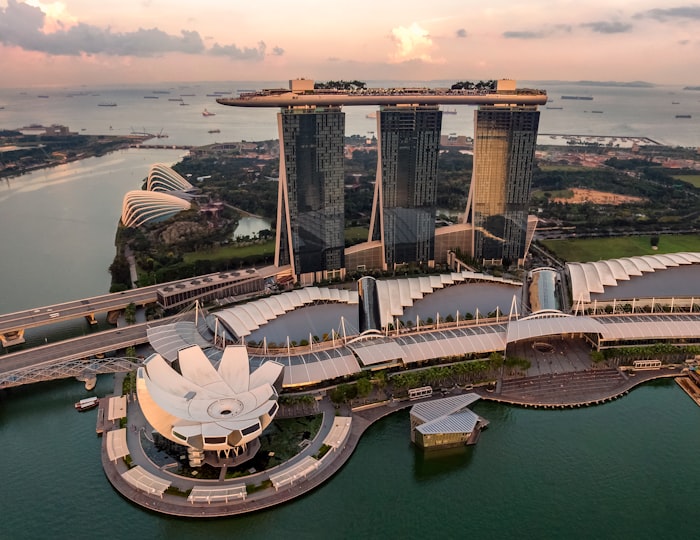
The short version: Singapore is one degree north of the equator and it shows — there is no “dry season” in the way Bali or Bangkok has one. It is hot, humid and rains somewhere on the island almost every week of the year. The real variable isn’t temperature, it’s how much rain falls and how long the downpours last. December and January bring the Northeast Monsoon and the wettest, stormiest stretch; June to September is marginally drier and is the best window for outdoor plans, though “drier” in Singapore still means a thunderstorm most afternoons.
The year-round baseline
Singapore’s temperature barely moves across the calendar: daytime highs sit at 31–33°C (88–91°F) essentially every month, overnight lows rarely drop below 23–25°C (73–77°F). Humidity averages 80–85% year-round. What changes is rainfall, wind direction and how often the sky opens up mid-afternoon. There is no cold season, no need for anything heavier than a light rain jacket, and no month where you’ll need to pack differently for temperature — only for rain.
Northeast Monsoon: December to early March
This is Singapore’s wet season proper. December and January are the wettest months of the year, averaging 280–330mm of rainfall each, often arriving as sustained, multi-hour downpours rather than the sharp afternoon storms typical of the rest of the year. Late December through early January also coincides with the tail end of the monsoon surge — periods of several consecutive rainy days are common, and flash flooding on low-lying roads (parts of Orchard Road, Bukit Timah) happens most years. It’s not a bad time to visit — indoor Singapore (Gardens by the Bay’s conservatories, the museums, Jewel Changi, the entire hawker centre culture) is built for this — but expect your outdoor plans to need a backup.
Inter-monsoon: April–May and October–November
These transitional windows bring the most unpredictable weather of the year: light, shifting winds mean thunderstorms can build fast in the early afternoon with little warning, often accompanied by Singapore’s most dramatic lightning displays (the island has one of the highest lightning-strike frequencies in the world, concentrated in these shoulder months). Rainfall totals are actually similar to the wetter months, but storms tend to be shorter and more localised — one part of the island gets drenched while another stays dry.
Southwest Monsoon: June to September
This is the closest Singapore gets to a “good season” — rainfall drops to its lowest levels of the year (150–170mm/month) and you get more genuinely dry stretches between storms. It’s also, unfortunately, haze season: smoke drifting north from agricultural burning in Sumatra and Kalimantan can push Singapore’s PSI (Pollutant Standards Index) into unhealthy territory for days at a stretch, typically peaking in August–September in dry years. Check haze.gov.sg if you’re visiting in late summer and have respiratory sensitivities — some years pass with barely a trace of haze, others (notably 2015, 2019) were bad enough to close outdoor schools.
So, when should you actually go?
| Window | What to expect | Verdict |
|---|---|---|
| Feb–March | Monsoon easing, rainfall dropping, still humid | Strong pick — quieter after Chinese New Year crowds clear |
| Jun–Aug | Driest stretch, but haze risk climbs late in the window | Good, watch the haze index in Aug |
| Dec–Jan | Wettest, but also festive (Christmas lights, NYE) | Fine if you don’t mind rain and love the light shows |
| Apr–May / Oct–Nov | Sudden, dramatic storms, less predictable | Skip if your plans are outdoor-heavy |
Practical packing and planning notes
- Pack light, breathable clothing and one genuinely waterproof (not just water-resistant) light jacket — umbrellas are cheap and sold everywhere, including inside MRT stations, if you forget one.
- Most of Singapore’s big attractions are built around the rain, not despite it — Gardens by the Bay, ArtScience Museum, the Cloud Forest, Jewel Changi’s Rain Vortex, and the entire underground/mall-linked city centre mean a downpour rarely derails a day.
- Afternoon storms (roughly 2–5pm) are the most reliable pattern outside monsoon season — plan outdoor activities (Botanic Gardens, Sentosa beaches, rooftop bars) for the morning.
- Air-conditioning indoors is aggressive by design — bring a light layer for malls, cinemas and the MRT even in the middle of the hottest month.
- Dengue is present year-round and ticks up slightly after wet spells — use repellent in the evenings, especially around parks and green corridors.
Travelling during a rainy stretch? A decent travel insurance policy covers weather-disrupted flights and activities, not just medical costs. We use and recommend SafetyWing for exactly this kind of trip.
Month-by-month rainfall reference
| Month | Avg rainfall | Rain days | Notes |
|---|---|---|---|
| January | ~250mm | ~15 | Peak Northeast Monsoon, wettest stretch |
| February | ~110mm | ~9 | Noticeably drier, Chinese New Year period |
| March | ~160mm | ~13 | Monsoon tail-off, humidity rising |
| April | ~165mm | ~14 | Inter-monsoon storms begin |
| May | ~165mm | ~14 | Warmest month, dramatic afternoon storms |
| June | ~140mm | ~11 | Southwest Monsoon begins, drier stretch starts |
| July | ~155mm | ~11 | School holidays, generally reliable weather |
| August | ~155mm | ~12 | Haze risk starts climbing |
| September | ~170mm | ~12 | Peak haze-risk window in bad years |
| October | ~190mm | ~13 | Inter-monsoon storms return |
| November | ~255mm | ~16 | Northeast Monsoon builds |
| December | ~285mm | ~17 | Wettest month, festive season |
Figures are long-term averages and vary year to year — treat this as a planning guide, not a forecast. The clearest pattern: February is consistently the driest single month, December the wettest.
Weather and Singapore’s event calendar
A few dates worth cross-referencing with the seasonal patterns above. Chinese New Year (late January or February, date shifts each year) lands right as the monsoon eases — one of the more pleasant windows weather-wise, but also one of the busiest for domestic crowds and closed businesses during the public holiday itself. The Great Singapore Sale and mid-year school holidays (June) fall in the drier Southwest Monsoon window. National Day (August 9) sits inside the haze-risk period in bad years, worth checking the PSI if you’re planning to be outdoors for the fireworks and parade. Christmas and New Year (December) coincide with the wettest weeks of the year but also Orchard Road’s light displays, which are worth seeing even in the rain.
Does Singapore get typhoons?
No — and this trips up a lot of first-time visitors comparing Singapore to Hong Kong or the Philippines. Singapore sits too close to the equator for tropical cyclones to form or intensify (they need a certain minimum distance from the equator to develop the necessary rotational force). What Singapore gets instead is intense but localised convective thunderstorms — sometimes called Sumatra squalls when they roll in overnight from the direction of Sumatra with strong winds and heavy rain, most common between April and November. They can be dramatic (waterspouts over the strait aren’t unheard of) but they’re short-lived, typically clearing within an hour or two, unlike the multi-day disruption a typhoon causes elsewhere in the region.
Frequently Asked Questions
Is there a truly dry season in Singapore?
No. Every month averages at least 130–150mm of rain. “Dry season” in Singapore just means less frequent, shorter storms — pack for rain no matter when you go.
What’s the hottest month?
May and June are typically the warmest, with daytime highs occasionally touching 35°C, though the difference from the rest of the year is marginal.
Does haze affect tourists every year?
No — it’s highly variable by year and dependent on Indonesian burning practices and wind direction. Some years (2020–2023) were largely haze-free; others were not. Check the NEA’s PSI readings if visiting July–October.
Do I need a raincoat or just an umbrella?
An umbrella is sufficient for 90% of situations — Singapore’s rain, even at its heaviest, is rarely accompanied by strong sustained wind the way a typhoon-adjacent storm would be. A packable rain jacket is a nice-to-have for outdoor activities (hiking MacRitchie Reservoir, for instance) where you need your hands free.
Is Singapore’s weather different from Malaysia or Indonesia’s?
Not meaningfully — Singapore sits at the southern tip of the Malay Peninsula and shares its equatorial climate with nearby Johor Bahru and the Riau Islands. The main practical difference from, say, Bali or Bangkok is the total absence of a genuine dry season here; both of those cities have a real several-month stretch with minimal rain, Singapore does not.